




Thursday, 27 August 2026 01:30 PM
Product Announcements
Built for automated defect detection, precision manufacturing inspection, and electronics quality control that need to resolve the smallest flaw across a wide field of view, this camera pairs the Onsemi HyperLux LP AR2020 sensor with VCM autofocus, Dynamic ROI, and low-noise imaging over USB 3.2 Gen 1, giving quality inspection system integrators genuine 20MP detail without a proprietary interface to manage.
FORT WORTH, TX / ACCESS Newswire / August 27, 2026 / Vadzo Imaging, a world leader in embedded vision solutions, today announced the validation of Autofocus and Software Controlled Focus on the Falcon-2020CRH, a 20MP Autofocus Color USB Camera built around the Onsemi HyperLux LP AR2020 sensor for automated defect detection, precision manufacturing inspection, and electronics quality control applications that need to resolve fine detail across a full field of view.
Why Industrial Quality Inspection Needs a 20MP Autofocus USB Camera Built for Fine Detail
Automated quality inspection systems face a resolution problem that becomes more demanding as manufacturing tolerances tighten and defect sizes shrink. A camera that lacks sufficient resolution can miss a hairline crack, a misaligned component, or a subtle surface defect entirely, not because the defect was not present in the frame but because it was smaller than the camera's effective pixel resolution could distinguish from surrounding material. Increasing magnification to compensate narrows the field of view, which forces an inspection station to either accept a smaller inspection area per camera or add more camera units to cover the same part.
A 20MP Dynamic ROI USB Camera approaches that balance differently, offering enough resolution to resolve fine defects across a genuinely wide field of view while retaining the ability to read out a smaller region at a higher frame rate when a specific area needs closer, faster examination. That combination matters directly for inspection stations that cannot afford to choose between broad coverage and detailed local examination.
A second, related challenge is inspecting parts that vary in position or height on a production line, which a fixed focus lens cannot accommodate without either constant manual refocusing or accepting blur on parts outside its narrow depth of field. A VCM Autofocus ROI Camera solves that problem electronically, adjusting focus for each part as it moves through an inspection station without a technician intervening between cycles.
Resolution and focus flexibility do not solve an inspection problem independently of each other. A camera with enough resolution to catch a fine defect but fixed focus for a single part height will still miss defects on parts that fall outside that narrow focus range, and a camera with excellent autofocus but insufficient resolution will keep every part in focus while still failing to resolve the flaw that actually matters. Addressing both from the same sensor platform is what makes a camera genuinely suited to a real production line rather than merely adequate in a controlled bench demonstration.
Engineering Explanation: Resolution, Focus, and Selective Readout Together
Onsemi designed the HyperLux LP AR2020 specifically for high-resolution industrial inspection applications where both fine detail and low-noise imaging matter equally. As an Onsemi AR2020 Autofocus Camera, the sensor delivers 20 megapixel resolution while maintaining the low noise characteristics that make subtle defects distinguishable from normal material variation rather than lost in sensor noise. A low-noise autofocus camera configuration like this one gives quality inspection integrators confidence that a flagged defect is real rather than an artifact of the imaging system itself.
That resolution and noise performance work alongside autofocus rather than as separate considerations. As an AR2020 VCM Autofocus USB Camera, the Falcon-2020CRH adjusts focus electronically as parts of varying height or position move through an inspection station, which matters directly for production lines where parts are not always presented at a perfectly consistent distance from the camera. An Autofocus ROI USB Module configuration combines that focus flexibility with the ability to examine a smaller region at higher speed when a specific area needs closer inspection.
Dynamic ROI extends the sensor's usefulness beyond full-frame capture alone. As a 20MP Dynamic ROI Autofocus Camera, the AR2020 can be configured to read out a smaller, defined region of the sensor at a substantially higher frame rate than a full frame capture would allow, which matters for inspection stations that need to examine a specific feature quickly without sacrificing the wide field resolution available when a broader view is needed. A 20MP ROI Autofocus Camera configuration like this one gives inspection system integrators the flexibility to choose between comprehensive coverage and fast, localized examination from the same hardware.
Delivering all of this over USB 3.2 Gen 1 is the final piece of the design. As an AR2020 Autofocus USB Camera, the Falcon-2020CRH enumerates as a standard UVC device without a proprietary driver, and functioning as a 20MP VCM USB Camera, it gives quality inspection system integrators a familiar, widely supported connectivity option rather than a specialized interface that would complicate integration with existing inspection software.
Product Overview
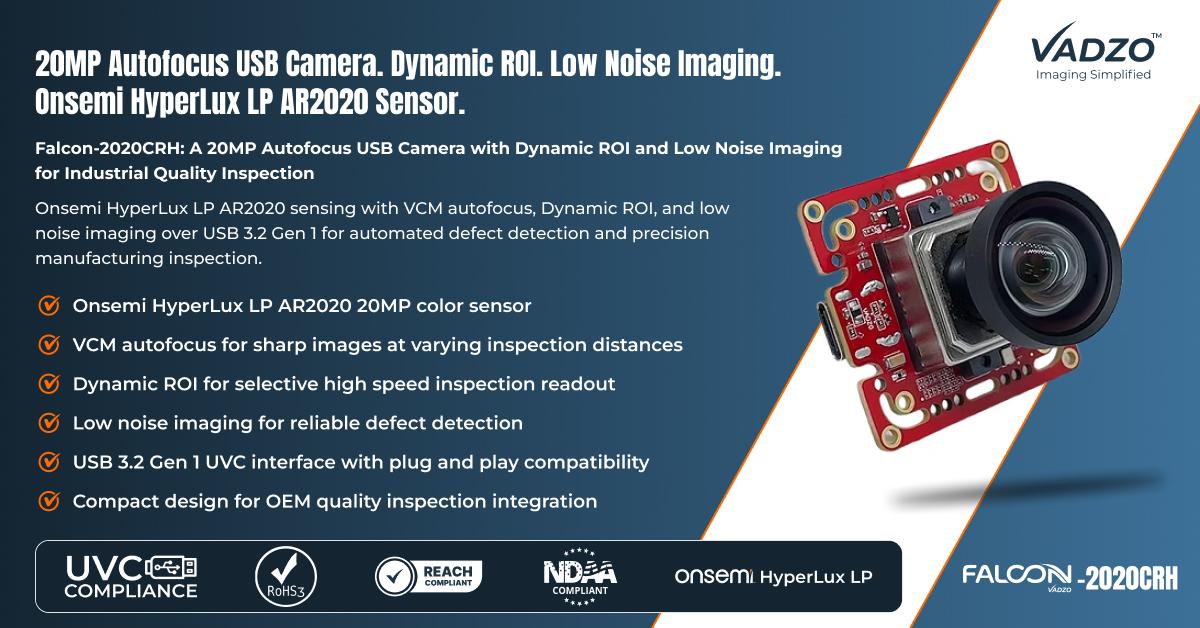
The Falcon-2020CRH pairs the AR2020 Autofocus Camera sensor with VCM autofocus, Dynamic ROI, and low-noise imaging in a compact design suited to automated inspection, manufacturing quality control, and electronics inspection integration. As a 20MP Autofocus USB Camera, it outputs full 20-megapixel resolution with autofocus and low-noise processing active by default, giving quality inspection integrators a single camera platform that covers wide-field defect detection, close examination, and general-purpose manufacturing vision from one module.
At the core of the module sits the AR2020 sensor, chosen specifically for the combination of resolution, autofocus range, and low noise sensitivity that quality inspection applications require. Because the camera pairs AR2020 Low Noise Sensor sensitivity with 20MP Low Noise Sensor imaging, the Falcon-2020CRH reaches usable image quality across a full production line's varied part positions and lighting while resolving detail fine enough for genuinely demanding inspection tolerances.
Product Specifications
Key specs: 20MP (5120 × 3840) | Onsemi AR2020 HyperLux LP 1/1.8 inch | 1.4 µm Pixel | Color | Rolling Shutter| USB 3.2 Gen 1 | UVC Compliant Interface | S Mount (M12 Standard) with VCM Autofocus Optics
Key Capabilities
Onsemi HyperLux LP AR2020 Sensor for Ultra-High-Resolution 20MP Capture: The Falcon-2020CRH is built around the Onsemi HyperLux LP AR2020 sensor, a device engineered specifically for industrial inspection applications that need to resolve fine detail across a genuinely wide field of view. This gives the module genuine 20MP Autofocus Sensor Module performance suited to inspection tasks that would otherwise require narrowing the field of view or adding additional camera units to achieve comparable defect detection sensitivity. As a High Precision Inspection Camera, it delivers that sensitivity without compromise. That level of sensitivity matters most on production lines where defect tolerances have tightened over time, since a camera specified for yesterday's tolerance requirements may no longer catch the smaller flaws a more demanding quality standard now requires.
VCM Autofocus for Sharp Images Across Varying Inspection Distances: Parts moving through an inspection station rarely present themselves at a perfectly consistent distance from the camera, whether due to normal variation in part handling or intentional design differences between product variants inspected on the same line. The included VCM autofocus lens assembly adjusts electronically for each of these situations, keeping the part in focus without requiring a technician to tune the lens for a single assumed distance that may not match how the line is actually running.
ROI-Based Autofocus for Precision on the Feature That Matters: A focus algorithm that averages sharpness across the entire frame can converge on a background element instead of the part feature an inspection task is actually built around, particularly when a scene includes surfaces at different distances. The Falcon-2020CRH's ROI-based autofocus evaluates focus specifically within a defined region of interest, so the lens locks onto the feature the inspection station is set up to examine rather than a frame-wide average, which matters directly for stations pairing Dynamic ROI readout with autofocus on the same targeted area.
Software and Hardware Controlled Focus for Flexible Integration: Different inspection stations trigger a refocus differently: a fully automated line needs the camera's own software pipeline to command a refocus without operator involvement, while a bench setup or manual inspection station needs a technician to force one directly. The Falcon-2020CRH supports both, accepting focus commands from host software over USB for automated sequences and a physical trigger input for hardware-driven refocus, so integrators are not committed to a single control architecture before a station's operating procedure is finalized.
Real Time Dynamic ROI for Selective High Speed Inspection Readout: Not every inspection task requires examining the full sensor field of view at maximum resolution and reading out the entire array; when only a specific feature needs close examination, it wastes both bandwidth and inspection cycle time. The Falcon-2020CRH lets integrators define a smaller readout region that streams at a meaningfully higher frame rate, which matters for high throughput inspection lines where cycle time directly affects production rate. A station that can shift between full field coverage and a fast, targeted readout on demand avoids the compromise of permanently sacrificing either thorough inspection or line speed to accommodate a camera that can only do one or the other well.
Low Noise Imaging for Reliable Defect Detection: Sensor noise that goes unaddressed can mask a genuine subtle defect or, just as problematically, create false positive detections that waste inspection time investigating artifacts rather than real quality issues. The Falcon-2020CRH's low noise design keeps that signal clean, giving automated inspection algorithms a more reliable basis for distinguishing an actual defect from ordinary material or lighting variation. As a 20MP low-noise USB Camera, it delivers that clean signal at the full resolution the sensor supports.
USB 3.2 Gen 1 UVC Plug and Play Compatibility: As a USB 3.2 UVC Camera Module, the Falcon-2020CRH enumerates automatically on Windows, Linux, macOS, and Android without a proprietary driver installation, which matters directly for quality inspection system integrators building on existing machine vision software that already expects a standard UVC device. This makes it a genuine Autofocus USB Camera Module option for integrators who need high-resolution autofocus imaging without a specialized interface or a custom capture card. As a USB 3.2 Autofocus Inspection Camera, it delivers that combination specifically at the bandwidth USB 3.2 Gen 1 provides.
Compact OEM-Ready Design for Quality Inspection Integration: Inspection equipment manufacturers producing stations at scale need a camera platform that stays consistent across a long production run. Vadzo Imaging supports full customization on this platform as an OEM Quality Inspection Module, including connector changes, optics selection, and firmware adjustments for manufacturers headed into volume production across multiple inspection product lines.
"Quality inspection teams keep telling us the same thing: a camera that cannot resolve a defect clearly enough, or that introduces enough noise to trigger false detections, is not actually solving their quality problem; it is just moving the uncertainty downstream. The AR2020's 20-megapixel resolution combined with low-noise imaging and VCM autofocus gives the Falcon-2020CRH genuine confidence in what an inspection system sees, delivered over a standard USB connection quality team already know how to integrate. We built this camera for lines where a missed defect has a real cost." - Alwin Vincent, Product Manager at Vadzo Imaging.
Application-Specific Sections
Automated Defect Detection: Automated defect detection systems need enough resolution to distinguish a genuine flaw from normal material variation across a wide field of view, without the cost of adding camera units to cover the same inspection area. As an Industrial Quality Inspection Camera, the Falcon-2020CRH's 20-megapixel resolution and low-noise imaging support that level of detection confidence, and functioning as a Defect Detection USB Camera, it extends the same reliability to automated pass and fail decisions at the same station.
Precision Manufacturing Inspection: Precision manufacturing inspection depends on resolving fine tolerances and surface characteristics that a lower resolution camera would simply not capture with enough detail to evaluate reliably. As a Precision Quality Inspection Camera, the Falcon-2020CRH delivers that resolution, and an Industrial Inspection Autofocus Camera configuration of the same module adds the focus flexibility needed as parts of varying dimensions move through the same station.
Electronics and PCB Inspection: Electronics and circuit board inspection requires resolving extremely fine features, from solder joints to component placement, across a board that may vary in height or position from one unit to the next. A Manufacturing Inspection Camera Module built on this platform resolves that fine detail, and its VCM autofocus keeps focus accurate as board height and component placement vary from unit to unit on the same line.
Automated Quality Control Systems: Automated quality control systems making pass or fail decisions depend on consistent, reliable image data across every unit inspected, not just the units that happen to be positioned ideally. As an Automated Quality Camera Module, the Falcon-2020CRH supports that consistency, and a Vision Quality Control Sensor configuration of the same module integrates directly with existing automated quality control software and decision logic. That direct integration reduces the engineering work needed to connect a new camera to an existing pass and fail decision pipeline, since the image data arrives in a format the quality control software is already built to interpret.
OEM Integration for Inspection Equipment Manufacturers: Inspection equipment manufacturers building their own quality control stations need a camera vendor who understands the resolution, focus, and connectivity requirements those systems demand. The Falcon-2020CRH ships with those requirements built in from the start, and Vadzo Imaging supports OEM customization for cable length, connector type, and firmware for manufacturers standardizing one camera across multiple inspection product lines. As a Quality Control Vision Camera, it fits directly into an equipment manufacturer's existing platform architecture.
Frequently Asked Questions
Q: Why does a quality inspection camera need 20MP resolution rather than a lower resolution sensor?
A: Higher resolution gives an inspection system more pixels to work with when examining a defect, tolerance, or fine surface characteristic, which directly affects how small a flaw can be reliably distinguished from normal material variation within a given field of view. A lower resolution camera forces integrators to either narrow the field of view to maintain enough pixel detail on the inspection area or accept reduced defect detection sensitivity across a wider scene. Vadzo Imaging's Falcon-2020CRH 20MP Autofocus USB Camera is designed to eliminate this trade-off by combining 20MP resolution with autofocus capability, enabling inspection system integrators to achieve wide field coverage while maintaining the pixel density required for fine defect detection.
Q: What is ROI-based autofocus, and how is it different from Dynamic ROI readout?
A: Dynamic ROI readout controls which portion of the sensor is read out and at what frame rate, while ROI-based autofocus controls where the focus algorithm evaluates sharpness. A camera that only supports Dynamic ROI can still autofocus on the wrong part of a scene if the focus evaluation covers the full frame rather than the readout region itself. Falcon-2020CRH's ROI-based autofocus evaluates sharpness within the defined region of interest, so the lens converges on the feature a station is set up to examine rather than an average of the whole scene, which matters directly when Dynamic ROI and autofocus are used together on the same targeted area.
Q: Why does an inspection camera need low noise imaging specifically, rather than just increasing exposure time to get a cleaner image?
A: Increasing exposure time can reduce visible noise in static scenes, but it can also slow down image capture and impact production cycle times, especially when inspecting moving parts. Low-noise sensor technology addresses this challenge by capturing cleaner image data at the exposure speeds required for real manufacturing environments. Vadzo Imaging's Falcon-2020CRH uses the Onsemi HyperLux LP AR2020 sensor with low-noise imaging performance, helping automated inspection systems distinguish actual defects from image artifacts while maintaining high-speed production operation.
Q: What is a dynamic region of interest readout, and why would an automated inspection system need it?
A: Dynamic region of interest readout lets a camera capture a smaller, defined portion of its full sensor array at a significantly higher frame rate than reading out the entire frame would allow, while retaining full resolution capture when a wider view is needed. Falcon-2020CRH integrates Dynamic ROI capability with 20MP imaging, allowing system integrators to balance detailed full-field inspection with faster localized analysis using the same camera platform. For a high-throughput inspection line, that flexibility means a station can examine a specific feature at higher speed without the full frame data volume slowing down inspection cycle time. Vadzo Imaging builds this capability into its inspection camera products so integrators can balance thorough wide field coverage against the throughput demands of a fast-moving production line from the same hardware. Configuring that balance in software rather than swapping hardware between inspection tasks also means a single camera model can serve multiple stations with different throughput requirements across the same facility.
Q: Can Vadzo Imaging customize a quality inspection camera module for a specific manufacturing or inspection platform?
A: Yes. Vadzo Imaging supports full OEM customization across its quality inspection camera portfolio, including optics selection suited to a specific working distance or field of view, connector and cable configuration matched to a particular inspection station design, and firmware adjustments tuned for a specific Dynamic ROI or noise reduction profile. Evaluation units ship with no minimum order requirement, and the same engineering team that built the standard product works directly with inspection equipment manufacturers to adapt the module for a specific manufacturing or quality control platform headed into volume production.
Q: What should manufacturers and quality control system integrators look for when selecting a camera supplier for an automated inspection platform?
A: An inspection platform requires consistent image quality and reliable detection performance across every inspected unit. Integrators should evaluate factors such as resolution, low-noise imaging performance, autofocus capability, flexible image readout options, standard connectivity, and long-term product support. Falcon-2020CRH combines the Onsemi AR2020 20MP sensor, VCM autofocus, Dynamic ROI, low noise imaging, and USB 3.2 Gen 1 connectivity to provide a reliable camera solution for automated defect detection, precision manufacturing inspection, and quality control systems. Vadzo Imaging builds its quality inspection camera products around exactly these priorities, since a camera that performs well in a demo but varies from unit to unit is not actually suitable for an automated quality control platform.
Availability
The Falcon-2020CRH 20MP Autofocus USB Camera is available now for evaluation and OEM integration. Evaluation kits include the camera module, a factory-calibrated autofocus lens, a USB 3.2 Gen 1 cable, and integration documentation covering Dynamic ROI configuration and autofocus setup, with no minimum order requirement. Contact Vadzo Imaging at [email protected] to request an evaluation unit or discuss volume production and OEM customization. Evaluation feedback is also welcome directly through the same contact channel, since real production line deployment conditions often surface details a bench test alone would not reveal, and that feedback helps confirm a configuration before a manufacturer commits to a full production order.
About Vadzo Imaging
Vadzo Imaging develops embedded and machine vision camera products for OEMs, system integrators, and inspection equipment manufacturers building production-ready vision systems across industrial automation, quality control, robotics, and edge AI. The company's portfolio spans MIPI CSI-2, USB, GigE, Wi-Fi, FPD-Link III, and SerDes interface camera products, supporting deployment architectures from compact onboard modules to distributed networked installations. Vadzo provides end-to-end imaging support, including sensor integration, ISP tuning, firmware development, and SDK frameworks to accelerate system deployment, and the company's engineering team works directly with customers throughout evaluation, pilot deployment, and volume production rather than handing off support after the initial sale. Visit Vadzo Imaging to explore the full embedded vision camera portfolio.
Media Contact
Alwin Vincent
Vadzo Imaging
Email: [email protected]
LinkedIn: Vadzo Imaging
YouTube: Vadzo Imaging
X: Vadzo Imaging
SOURCE: Vadzo Imaging